Parallelism Measurement of the Top and Bottom Surfaces of a Lens Barrel
・Issues
Even slight tilt or parallelism errors in a lens barrel can significantly degrade optical performance, causing image distortion, defocusing, and uneven focus. In high-performance lenses, even minute errors directly affect image quality, making stringent control of the parallelism between the top and bottom surfaces essential. Conventional methods, however, require considerable measurement time and adjustment by skilled technicians, creating demand for a faster and easier evaluation method.
・Solutions
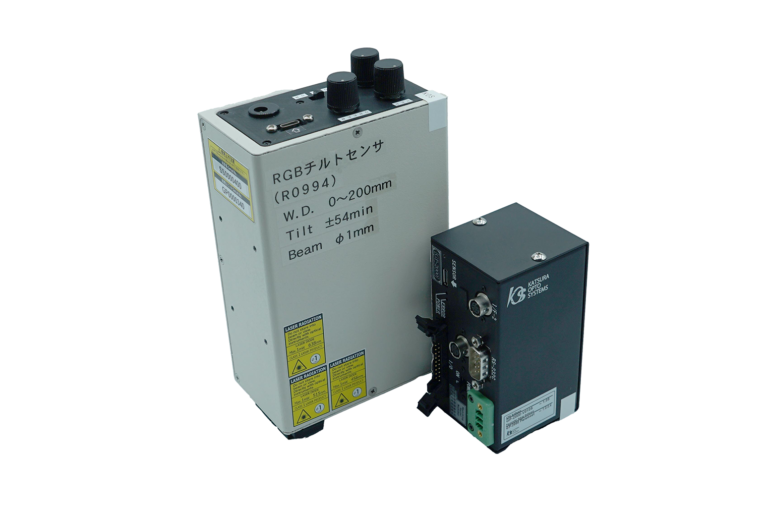
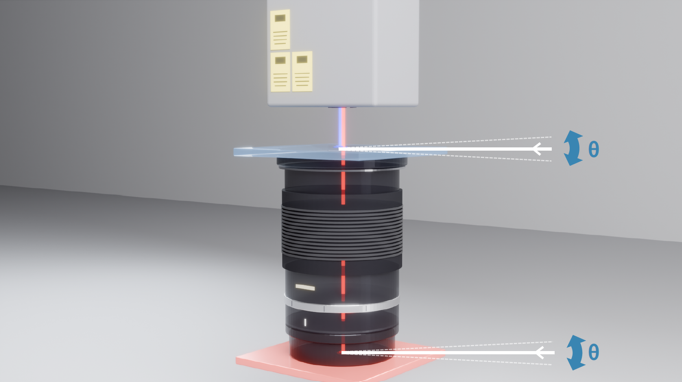
The RGB tilt sensor is a multi-wavelength autocollimator equipped with red, green, and blue lasers along the same optical path. Optical components that reflect different wavelengths are installed on the top and bottom surfaces of the lens barrel. The sensor directs laser light to these components and detects the reflected light. By measuring the angle of each surface simultaneously, the parallelism between the top and bottom surfaces can be determined. Results are available immediately, providing the following benefits:
・Preventing rework through early detection of optical-axis misalignment
・Improving and standardizing assembly accuracy
・Significantly reducing inspection and adjustment time
By visualizing previously undetectable minute errors in real time, lens-barrel quality can be evaluated faster and more efficiently.